Note
Go to the end to download the full example code or to run this example in your browser via Binder
Diagnostics for Importance Sampling
This notebook illustrates the use of some simple diagnostics for Importance Sampling. For IS, in extreme settings only a few samples may have a significant weight, yielding poor approximations of the target pdf \(p(x)\). A popular diagnostics is the Effective Sample Size (ESS), which is theoretically defined as the number of independent samples generated directly form the target distribution that are required to obtain an estimator with same variance as the one obtained from IS. Heuristically, ESS approximates how many i.i.d. samples, drawn from the target, are equivalent to \(N\) weighted samples drawn from the IS or MCMC approximation.
An approximation of the ESS is given by [1]:
where \(\tilde{w}\) are the normalized weights.
[1] Sequential Monte Carlo Methods in Practice, A. Doucet, N. de Freitas, and N. Gordon, 2001, Springer, New York
from UQpy.distributions import Uniform, JointIndependent
from UQpy.sampling import ImportanceSampling
import matplotlib.pyplot as plt
import numpy as np

def log_Rosenbrock(x, param):
    return (-(100 * (x[:, 1] - x[:, 0] ** 2) ** 2 + (1 - x[:, 0]) ** 2) / param)

proposal = JointIndependent([Uniform(loc=-8, scale=16), Uniform(loc=-10, scale=60)])
print(proposal.get_parameters())

w = ImportanceSampling(log_pdf_target = log_Rosenbrock, args_target = (20,),
                       proposal = proposal, nsamples=5000)
{'loc_0': -8, 'scale_0': 16, 'loc_1': -10, 'scale_1': 60}
Look at distribution of weights
print('max_weight = {}, min_weight = {} \n'.format(max(w.weights), min(w.weights)))

fig, ax = plt.subplots(figsize=(8, 3))
ax.scatter(w.weights, np.zeros((np.size(w.weights),)), s=w.weights * 600, marker='o')
ax.set_xlabel('weights')
ax.set_title('Normalized weights out of importance sampling')
ax.tick_params(which='both', left=False, labelleft=False)  # labels along the bottom edge are off
plt.show()
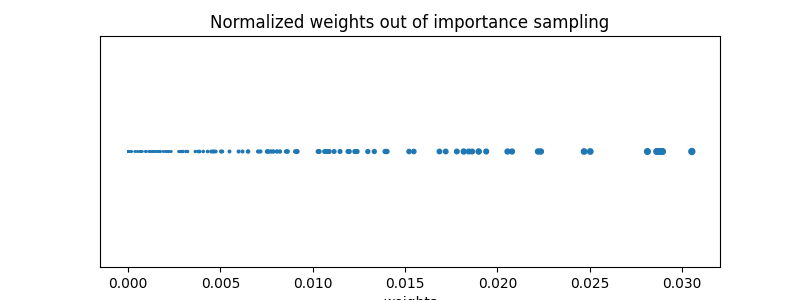
max_weight = 0.030535807988287457, min_weight = 0.0
Compute the effective sample size
effective_sample_size = 1. / np.sum(w.weights ** 2, axis=0)

print('Effective sample size is ne={}, out of a total number of samples={} \n'.
      format(effective_sample_size, np.size(w.weights)))
Effective sample size is ne=65.99974828422863, out of a total number of samples=5000
Total running time of the script: ( 0 minutes 0.055 seconds)
