Note
Go to the end to download the full example code or to run this example in your browser via Binder
SROM on a Gamma distribution 2
In this example, Stratified sampling is used to generate samples from Gamma distribution and weights are defined using Stochastic Reduce Order Model (SROM). This example illustrate how to define same weights for each sample of a random variable.
Import the necessary libraries. Here we import standard libraries such as numpy and matplotlib, but also need to
import the TrueStratifiedSampling and SROM class from UQpy.
from UQpy.surrogates import SROM
from UQpy.sampling import RectangularStrata
from UQpy.sampling import TrueStratifiedSampling
from UQpy.distributions import Gamma
import scipy.stats as stats
import matplotlib.pyplot as plt
import numpy as np
Create a distribution object for Gamma distribution with shape, shift and scale parameters as \(2\),
\(1\) and \(3\).
Create a strata object.
strata = RectangularStrata(strata_number=[4, 4])
Using UQpy TrueStratifiedSampling class to generate samples for two random variables having Gamma
distribution.
x = TrueStratifiedSampling(distributions=marginals,
                           strata_object=strata,
                           nsamples_per_stratum=1)
Run SROM using the defined Gamma distribution. Here we use the following parameters.
Gammadistribution with shape, shift and scale parameters as \(2\), \(1\) and \(3\).First and second order moments about origin are \(6\) and \(54\).
Notice that
pdf_targetreferences theGammafunction directly and does not designate it as a string.Samples are uncorrelated, i.e. also default value of correlation.
In this case, sample_weights are generated using default values of weights_distribution,
weights_moments and weights_correlation. Default values are:
print('weights_distribution', '\n', y1.weights_distribution, '\n', 'weights_moments', '\n', y1.weights_moments, '\n',
      'weights_correlation', '\n', y1.weights_correlation)

y2 = SROM(samples=x.samples, target_distributions=marginals, moments=[[6., 6.], [54., 54.]],
          properties=[True, True, True, False],
          weights_distribution=[[0.4, 0.5]], weights_moments=[[0.2, 0.7]],
          weights_correlation=[[0.3, 0.4], [0.4, 0.6]])
weights_distribution
 [[1. 1.]
 [1. 1.]
 [1. 1.]
 [1. 1.]
 [1. 1.]
 [1. 1.]
 [1. 1.]
 [1. 1.]
 [1. 1.]
 [1. 1.]
 [1. 1.]
 [1. 1.]
 [1. 1.]
 [1. 1.]
 [1. 1.]
 [1. 1.]]
 weights_moments
 [[0.02777778 0.02777778]
 [0.00034294 0.00034294]]
 weights_correlation
 [[1. 1.]
 [1. 1.]]
In second case, weights_distribution is modified by SROM class. First, it defines an array of size
\(2×16\) with all elements equal to \(1\) and then multiply first column by \(0.4\) and second column by
\(0.5\) . Similarly, weights_moments and weights_correlation are modified.
print('weights_distribution', '\n', y2.weights_distribution, '\n', 'weights_moments', '\n', y2.weights_moments, '\n',
      'weights_correlation', '\n', y2.weights_correlation)
weights_distribution
 [[1. 1.]
 [1. 1.]
 [1. 1.]
 [1. 1.]
 [1. 1.]
 [1. 1.]
 [1. 1.]
 [1. 1.]
 [1. 1.]
 [1. 1.]
 [1. 1.]
 [1. 1.]
 [1. 1.]
 [1. 1.]
 [1. 1.]
 [1. 1.]]
 weights_moments
 [[0.02777778 0.02777778]
 [0.00034294 0.00034294]]
 weights_correlation
 [[1. 1.]
 [1. 1.]]
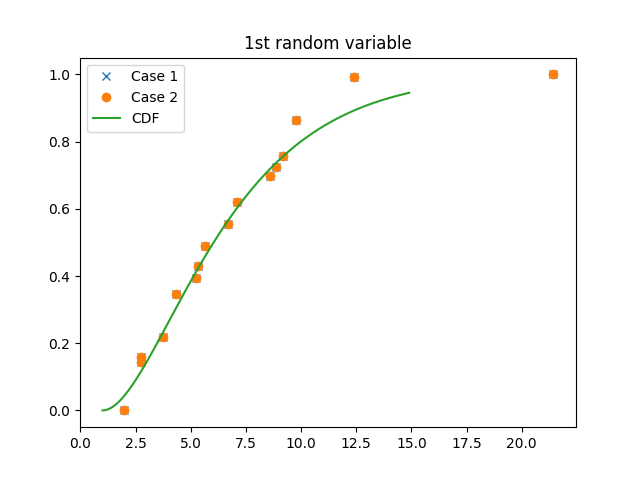
Plot below shows the comparison of samples weights generated using two different weights with the actual CDF of gamma distribution.
c1 = np.concatenate((y1.samples, y1.sample_weights.reshape(y1.sample_weights.shape[0], 1)), axis=1)
d1 = c1[c1[:, 0].argsort()]
c2 = np.concatenate((y2.samples, y2.sample_weights.reshape(y2.sample_weights.shape[0], 1)), axis=1)
d2 = c2[c2[:, 0].argsort()]
plt.plot(d1[:, 0], np.cumsum(d1[:, 2], axis=0), 'x')
plt.plot(d2[:, 0], np.cumsum(d2[:, 2], axis=0), 'o')
plt.plot(np.arange(1,15,0.1), stats.gamma.cdf(np.arange(1,15,0.1), 2, loc=1, scale=3))
plt.legend(['Case 1','Case 2','CDF'])
plt.title('1st random variable')
plt.show()
A note on the weights corresponding to distribution, moments and correlation of random variables:
For this illustration, default weights_moments are square of reciprocal of moments. Thus, moments should be of :any:’list[float]’ type.
Total running time of the script: ( 0 minutes 0.857 seconds)
