Note
Go to the end to download the full example code or to run this example in your browser via Binder
2D Helmholtz eigenvalues (2 random inputs, vector-valued output)
In this example, PCE is used to generate a surrogate model for a given set of 2D data for a numerical model with multi-dimensional outputs.
Import necessary libraries.
import numpy as np
import matplotlib.pyplot as plt
import math
from UQpy.distributions import Normal, JointIndependent
from UQpy.surrogates import *
The analytical function below describes the eigenvalues of the 2D Helmholtz equation on a square.
def analytical_eigenvalues_2d(Ne, lx, ly):
    """
    Computes the first Ne eigenvalues of a rectangular waveguide with
    dimensions lx, ly

    Parameters
    ----------
    Ne : integer
         number of eigenvalues.
    lx : float
         length in x direction.
    ly : float
         length in y direction.

    Returns
    -------
    ev : numpy 1d array
         the Ne eigenvalues
    """
    ev = [(m * np.pi / lx) ** 2 + (n * np.pi / ly) ** 2 for m in range(1, Ne + 1)
          for n in range(1, Ne + 1)]
    ev = np.array(ev)

    return ev[:Ne]
Create a distribution object.
pdf_lx = Normal(loc=2, scale=0.02)
pdf_ly = Normal(loc=1, scale=0.01)
margs = [pdf_lx, pdf_ly]
joint = JointIndependent(marginals=margs)
Define the number of input dimensions and choose the number of output dimensions (number of eigenvalues).
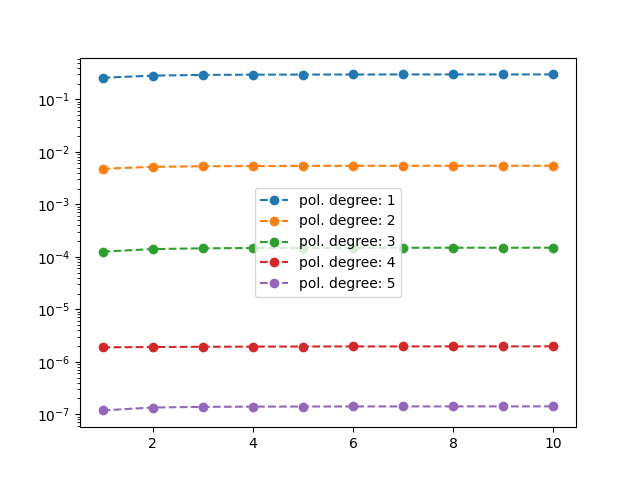
Construct PCE models by varying the maximum degree of polynomials (and therefore the number of polynomial basis) and compute the validation error for all resulting models.
errors = []
# construct PCE surrogate models
for max_degree in range(1, 6):
    print('Total degree: ', max_degree)
    polynomial_basis = TotalDegreeBasis(joint, max_degree)

    print('Size of basis:', polynomial_basis.polynomials_number)
    # training data
    sampling_coeff = 5
    print('Sampling coefficient: ', sampling_coeff)
    np.random.seed(42)
    n_samples = math.ceil(sampling_coeff * polynomial_basis.polynomials_number)
    print('Training data: ', n_samples)
    xx = joint.rvs(n_samples)
    yy = np.array([analytical_eigenvalues_2d(dim_out, x[0], x[1]) for x in xx])

    # fit model
    least_squares = LeastSquareRegression()
    pce_metamodel = PolynomialChaosExpansion(polynomial_basis=polynomial_basis, regression_method=least_squares)
    pce_metamodel.fit(xx, yy)

    # coefficients
    # print('PCE coefficients: ', pce.C)

    # validation errors
    np.random.seed(999)
    n_samples = 1000
    x_val = joint.rvs(n_samples)
    y_val = np.array([analytical_eigenvalues_2d(dim_out, x[0], x[1]) for x in x_val])
    y_val_pce = pce_metamodel.predict(x_val)
    errors.append(np.linalg.norm((y_val - y_val_pce) / y_val, ord=1, axis=0))
    print('Relative absolute errors: ', errors[-1])
    print('')
Total degree:  1
Size of basis: 3
Sampling coefficient:  5
Training data:  15
Relative absolute errors:  [0.25787331 0.28364754 0.29201537 0.29532324 0.29691008 0.29778109
 0.29831043 0.2986553  0.29889252 0.29906269]

Total degree:  2
Size of basis: 6
Sampling coefficient:  5
Training data:  30
Relative absolute errors:  [0.00475743 0.0051856  0.00531297 0.00536752 0.00539496 0.00541011
 0.00541937 0.00542546 0.00542968 0.00543271]

Total degree:  3
Size of basis: 10
Sampling coefficient:  5
Training data:  50
Relative absolute errors:  [0.00012562 0.00014033 0.00014521 0.00014706 0.00014794 0.00014842
 0.00014872 0.00014891 0.00014904 0.00014913]

Total degree:  4
Size of basis: 15
Sampling coefficient:  5
Training data:  75
Relative absolute errors:  [1.88728332e-06 1.90860554e-06 1.92961227e-06 1.94463745e-06
 1.95400955e-06 1.95956409e-06 1.96292959e-06 1.96512055e-06
 1.96687116e-06 1.96840806e-06]

Total degree:  5
Size of basis: 21
Sampling coefficient:  5
Training data:  105
Relative absolute errors:  [1.18499835e-07 1.34430527e-07 1.38327329e-07 1.39753722e-07
 1.40432776e-07 1.40809754e-07 1.41038037e-07 1.41186713e-07
 1.41288658e-07 1.41361880e-07]
Plot errors.
Moment estimation (directly estimated from the last PCE metamodel).
print('Mean PCE estimate:', pce_metamodel.get_moments()[0])
print('')
print('Variance PCE estimate:', pce_metamodel.get_moments()[1])
Mean PCE estimate: [ 12.34070845  41.95840874  91.32124256 160.4292099  249.28231077
 357.88054516 486.22391308 634.31241452 802.14604949 989.72481799]

Variance PCE estimate: [4.14672709e-02 6.26887565e-01 3.16370884e+00 9.99361227e+00
 2.43949515e+01 5.05827526e+01 9.37087143e+01 1.59861207e+02
 2.56065276e+02 3.90282635e+02]
Total running time of the script: ( 0 minutes 0.392 seconds)
